
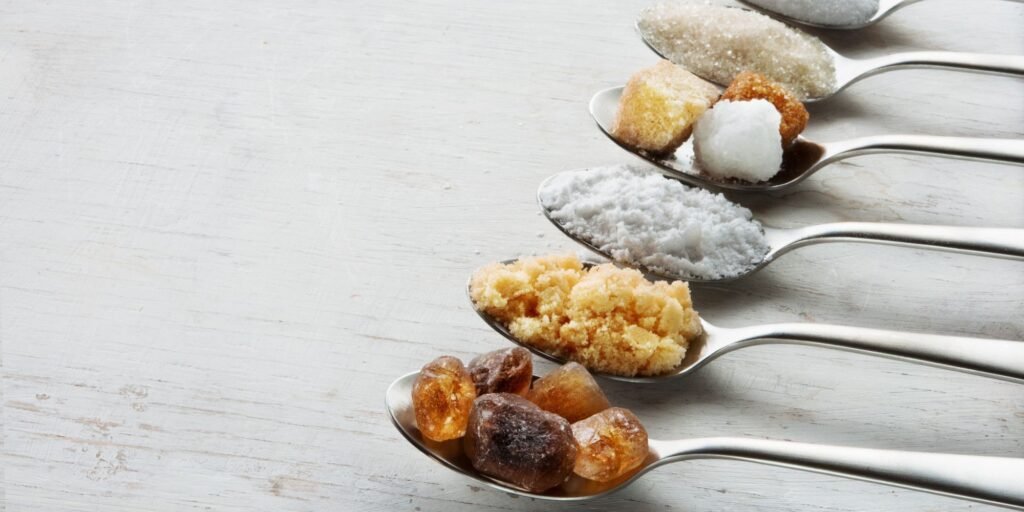
Sugar Alternatives: What’s Actually Better (and What’s Not)
The shift away from white sugar has created an entire world of alternatives.
But here’s the truth: Not all “natural” sugars are better. Not all artificial ones are harmful.
What matters is understanding:
- How your body processes them
- Their glycemic impact
- And where they actually make sense
A. Natural Sugar Alternatives (Common & Traditional)
These are often perceived as “healthier”. But the reality is more nuanced.
- Jaggery (Gur)
ADD A PICTURE HERE
- Glycemic Index (GI): 80–85 (high)
Positives: - Contains small amounts of minerals (iron, magnesium)
- Less processed than white sugar
- Traditional, culturally accepted
Limitations: - Raises blood sugar almost as much as sugar
- Mineral content is too small to make a real nutritional difference
- Easy to overconsume thinking it’s “healthy”
- Honey
ADD A PICTURE HERE
- Glycemic Index GI: 50–65 (varies by type)
Positives: - Contains antioxidants and trace enzymes
- Slightly lower GI than sugar
- Natural antimicrobial properties
Limitations: - Still high in calories and sugars
- Blood sugar impact still significant
- Often adulterated in commercial forms
- Coconut Sugar
ADD A PICTURE HERE
- Glycemic Index GI: 50–55 (moderate)
Positives: - Contains small amounts of minerals
- Slightly slower absorption than sugar
- Mild caramel flavour
Limitations: - Still calorie-dense
- GI difference is not dramatic enough to call it “safe”
- Overhyped as a “low GI” food
- Dates / Date Sugar
ADD A PICTURE HERE
- Glycemic Index GI: 40–50 (varies)
Positives: - Contains fiber (especially whole dates)
- Provides potassium and antioxidants
- Less processed
Limitations: - Still high in natural sugars
- Calorie dense
- Not suitable for strict blood sugar control
- Maple Syrup
ADD A PICTURE HERE
- Glycemic Index GI: 54
Positives: - Contains trace minerals (zinc, manganese)
- Less processed than refined sugar
Limitations: - High sugar content
- Nutritional benefit is minimal in real consumption quantities
- Brown Sugar
ADD A PICTURE HERE
- Glycemic Index (GI): 60–65
Positives: - Slightly less processed than white sugar
- Contains small amounts of molasses
- Marginally richer flavour (caramel notes)
Limitations: - Nutritionally almost identical to white sugar
- Minimal mineral content — not meaningful in real consumption
- Similar impact on blood sugar and calories
Reality: Brown sugar is often perceived as “healthier” but functionally, it behaves very much like
regular sugar.
- Stevia (Steviol Glycosides)
ADD A PICTURE HERE
- Glycemic Index (GI): 0
Positives: - Zero calories
- Does not raise blood sugar levels
- Plant-derived (from Stevia rebaudiana)
- Widely used in diabetic-friendly products
Limitations: - Can have a bitter or licorice-like aftertaste
- Often highly processed into purified extracts
- Usually blended with other agents (like erythritol or fillers)
- Taste profile doesn’t work well in all applications
Reality Check on Natural Sugars. Most natural sweeteners:
- Still raise blood sugar
- Still add calories
- Still need moderation
“Natural” does not automatically mean “better for metabolic health.”
- Naturally Derived Allulose & Erythritol (Next-Gen Low-Calorie Sweeteners)
- Glycemic Index (GI): 0
Positives: - Very low to zero calorie
o Allulose: 0.2–0.4 kcal/g
o Erythritol: 0 kcal - Minimal to no blood sugar impact
o Suitable for diabetics and low-carb diets - Closer taste to sugar
o Less bitterness compared to some alternatives - Naturally occurring
o Allulose: found in small quantities in figs, raisins
o Erythritol: found in fruits and fermented foods - Works well in formulations
o Provides bulk (unlike high-intensity sweeteners)
o Useful for baking and processed foods - Sweetness level
o Allulose 70% as sweet as sugar
o Erythritol 60–70% so it often needs blending
Limitations: - Erythritol has virtually no impact on blood glucose levels, though consuming it in high
quantities may lead to mild digestive discomfort in some individuals. - Allulose has minimal to no impact on blood sugar levels, and is generally well tolerated,
though very high intake may occasionally cause mild digestive discomfort in some
individuals.
Reality Check:
These are among the more functionally useful alternatives today, especially in packaged foods
because they balance- taste, texture and blood sugar impact, but like all sweeteners, they’re tools ;
not health foods on their own.
B. Artificial & Low-Calorie Sweeteners (Chemical Names)
These are widely used in “sugar-free” products.
- Aspartame
- Glycemic Index GI: 0
Positives: - Very low calorie
- Widely studied and approved in regulated amounts
Concerns: - Not heat-stable
- Some individuals report sensitivity
- Ongoing debate (though major authorities consider it safe in limits)
- Sucralose
- Glycemic Index GI: 0
Positives: - Heat stable (good for cooking)
- Zero calories
Concerns: - May affect gut microbiota (emerging research)
- Highly processed
- Saccharin
- Glycemic Index GI: 0
Positives: - Long shelf life
- No calories
Concerns: - Bitter aftertaste
- Historical safety debates (largely resolved but perception remains)
- Acesulfame Potassium (Ace-K)
- Glycemic Index GI: 0
Positives: - Stable in heat and storage
- Often blended with other sweeteners
Concerns: - Limited long-term independent studies compared to others
- Often used in ultra-processed foods
So Where Does Monk Fruit Fit In?
Monk fruit (Luo Han Guo) sits in a unique middle ground: - Naturally derived
- Zero glycemic impact
- No calories
What Makes It Different:
Positives: - Glycemic Index GI: 0 – does not spike blood sugar
- Suitable for diabetics and low-carb diets
- Heat stable (works in cooking and baking)
- Comes from a fruit, not synthetic chemistry
- No known major side effects in typical consumption
Considerations: - Often blended with other agents (like erythritol) in the market
- Pure extract can be expensive
Final Perspective
There is no “perfect” sweetener. But there are better choices depending on your goal: - For tradition – jaggery, honey
- For taste + familiarity – coconut sugar, dates
- For zero calorie – artificial sweeteners
- For balance – Monk Fruit Extract (pure) and Monk Fruit with Erythritol/ Allulose blends
The Bottom Line
If your goal is: - Lower sugar intake
- Stable energy
- Long-term metabolic health
Then choosing a sweetener that doesn’t spike blood sugar – without unnecessary additives –
becomes important.
And that’s where Of Earth’s monk fruit stands out quietly, not as a trend, but as a functional
alternative grounded in both nature and science.